
GRID. Oscar Wilde. Friend of Dorothy. The Mattachine Society. Edie Winsor. If you know who or what all five of those mean…congratulations you know your gay history!
Gay history is American history. Queer history is American history. Gay people have always existed – we have always been here. And, as it has always been throughout history, it is up to us to teach others our collective history. As I have said in this column before – the queer community takes care of itself.
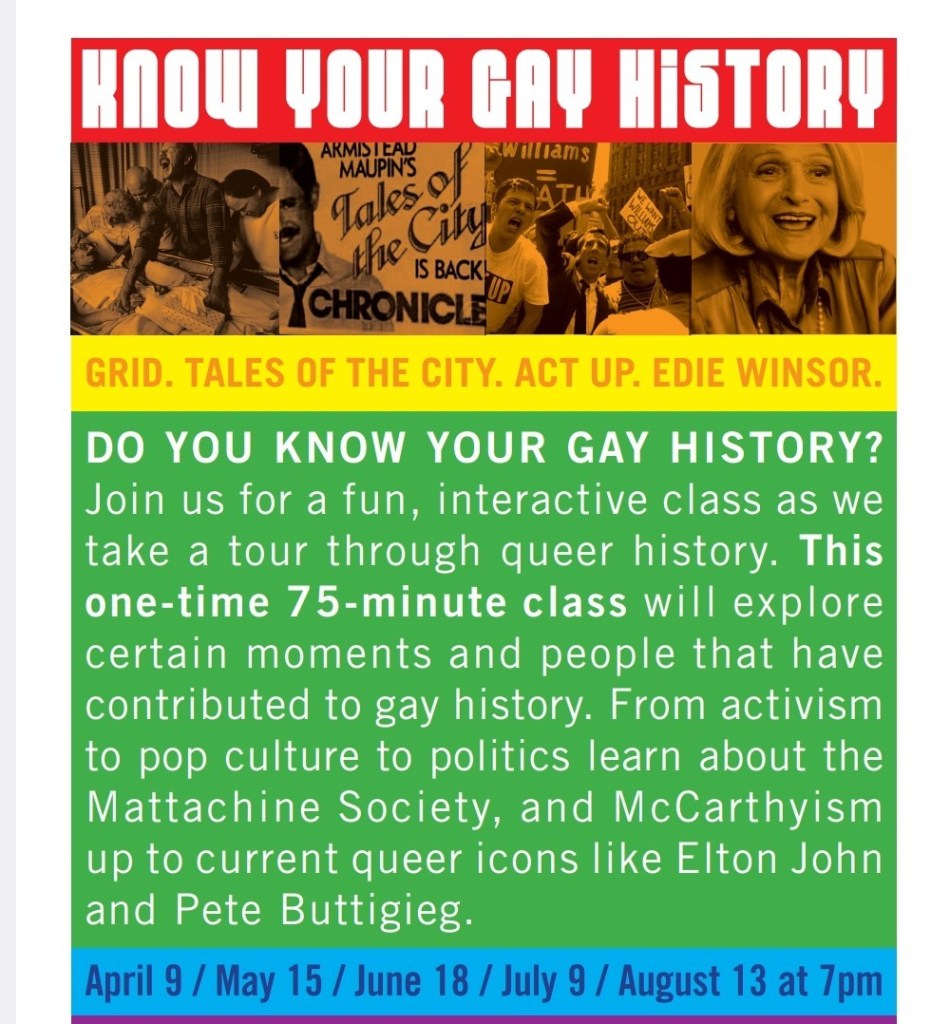
It is my honor and privilege to announce the beginning of a monthly class at the Lesbian, Gay, Bisexual, and Transgender Community Center (The Center) in NYC called – none other than – “Know Your Gay History.”
In creating this class and working on the curriculum I started reminiscing about my own personal gay history. Growing up gay in the 1970s-1990s was a completely different experience than growing up gay in the 2000s-2020s. Like night and day doesn’t even begin to cover how different it was. For me growing up in the 80s anything gay was honestly non-existent. There was NO ONE one for me to look up to or look at and see any sort of representation.
Yes, there were blips here and there. Billy Crystal in “Soap,” Harry Hamlin, and Michael Ontkean in “Making Love,” (also starring the beloved Kate Jackson.) The television shows “Maude” and “All in the Family” each introduced a gay character and started the dialogue. But I wasn’t even born when those episodes aired. I had no frame of reference or way to find a movie like “Making Love.” Remember this was a full two decades before the glorious World Wide Web existed.
Slowly the world evolved – the USA eons slower than a large majority of the rest of the civilized world – and change happened. “Will and Grace” and “Queer as Folk,” debuted on our television screens. Movies like “Trick” and “The Broken Hearts Club” spoke to us and made us feel seen. Sean Penn, Christopher Plummer, Cate Blanchett, Jared Leto, Eddie Redmayne and Mahershala Ali all won or were nominated for Oscars playing queer characters. After decades and decades of marching and protesting, marriage equality was finally passed in 2015. (If the current Presidential Administration plans on taking it away from us they are gonna have to pry it from my cold dead hands…and I ain’t even married.)
Queer culture has changed throughout history as well. Case in point, we have reclaimed the word queer – “Queer Nation,” “Queer Eye” – it’s no longer a slur. We have adopted it as our own with members of our community identifying as queer.
These younger generations came up in a more accepting world. The world that we created for them. We wanted them to be able to live openly and freely. We wanted their youth to be different from ours — and we achieved that. As Billy Eichner famously says in “Bros,” the first queer led romantic comedy, “Of course they are happy. They had Glee. We had AIDS.”
With that happiness and change, sometimes there is pushback or backlash. And some of that comes from within our own community. I mean we only have to look back to the “No fats, No Femmes, No Asians,” that used to be littered on sex apps to know that gay on gay discrimination exists. (Now it’s “No Total Bottoms” but that’s a discussion for another time.)
Different pronouns and guys wearing nail polish are just two examples of how queers in different generations express themselves. “It’s just not for me,” “I don’t get it,” or “They don’t even know who Judy Garland is,” are frequently heard phrases from some 65-year-old gay men talking about a 21-year-old gay person.
Of course they are different. Forty four years is a lifetime! There are so many aspects of gay culture that Gen Z has no frame of reference for including – who Harvey Milk, Harvey Firestein and Divine were. Or why Anita Bryant is so rightfully despised and why Cher is so universally adored. Cue the “Know Your Gay History” class.
Even with generational divides and differences we have to remember, as members of the queer community, we have MUCH more in common than different. Let’s celebrate those differences! And we can never forget that we are stronger together. Our umbrella needs every single letter LGBT and Q. Two trans women of color – Marsha P. Johnson and Sylvia Rivera – are credited with throwing the 1st brick at Stonewall. Although neither have said so personally. The lesbian community stepped up and served as caregivers to the countless gay men dying of AIDS in the 1980s.
Our queer history is long and rich. It’s time we all Know Our Gay History, aka American History!
To register for the Gay History class – tinyurl.com/knowyourgayhistory
(This column was originally published in the April edition of “Letters from Camp Rehoboth.”)
 The Gays of our Lives
Congrats
LikeLike